Bitcoin Mining Profits Turn Ugly Despite Hashrate’s Return Above 1 ZH/s
英文原文查看译文
阅读字号阅读正文 ↓
加载图片中
After shedding roughly 100 exahash per second (EH/s) in computational power, while bitcoin’s price retreated to levels last witnessed during the first week of September 2024, Bitcoin’s hashrate has rebounded decisively, reclaiming the 1,000 EH/s threshold, equivalent to 1 zettahash per second (ZH/s) of processing power. Financial Breathing Room Gets Thin for Bitcoin Miners Bitcoin’s […]
Key Takeaways
• Bitcoin’s hashrate has reclaimed the 1 ZH/s zone despite mounting financial pressure across the mining industry with bitcoin’s price tapping a two year low.
• Historically weak mining revenue and dwindling transaction fees are raising questions about the sustainability of current operations.
• An approaching difficulty adjustment could introduce fresh economic challenges for miners already navigating an unforgiving market.
Financial Breathing Room Gets Thin for Bitcoin Miners
Bitcoin’s price has endured a punishing stretch, with the world’s largest crypto asset by market capitalization tumbling to $55,081 on Bitstamp on Saturday. The price decline has dealt another significant blow to bitcoin miners, with revenue once again plumbing extreme lows as hashprice slips below $28 per petahash per second (PH/s) of daily computational output.
On Nov. 21, hashprice fell to a low of $26.16 per petahash per second (PH/s) per day, according to hashrateindex.com. Bitcoin miners have found little financial relief in transaction fees, with annual fee revenue tracking toward its lowest level since at least 2011.
Over the past 24 hours, fees accounted for a meager 0.64% of total block rewards, representing considerably less than 1% of miners’ total earnings. Consequently, mining operations remain heavily dependent on bitcoin’s market price, leaving their revenue particularly vulnerable to sharp fluctuations in the asset’s valuation.
American cryptocurrency entrepreneur Kyle Chassé offered a sobering assessment of the state of bitcoin mining to his 283,900 followers on X, observing that “bitcoin is now trading below what it costs to mine.” Drawing a comparison to the economics of precious metals extraction, Chassé added, “Think of a gold mine where every ounce sells for less than it cost to dig.”
“Miners in that spot have two options. Switch machines off, or sell coins to pay the bills. Hashrate is still sitting near record highs. Nobody has switched off yet.”
Chassé concluded with a pointed question that captures the financial predicament confronting the mining industry:
“So who blinks first, the miners or the price?”
Heavyweight ASIC Machines and Lightweight Profits
The financial strain becomes even more apparent when examining what today’s most advanced SHA-256 mining machines actually earn. At an electricity rate of $0.10 per kilowatt-hour (kWh), even newer hydro-cooled models are scraping by on surprisingly thin estimated daily profits. Consider Bitmain’s Antminer S23 Hydro 3U, which produces 1.16 PH/s of computational power yet generates an estimated profit of just $6.29 per day under current market conditions.
The figures become even less encouraging further down the list. Bitdeer’s Sealminer A4 Ultra Hydro (886 TH/s) and Bitmain’s Antminer S23 XP Hyd (600 TH/s) produce estimated daily profits of $4.92 and $4.12, respectively. Meanwhile, other machines operating between 318 TH/s and 865 TH/s are left with estimated daily profits ranging from a mere $0.58 to $3.66, and those figures exclude additional operating expenses.
For miners investing thousands of dollars in specialized equipment, meager returns like these illustrate just how unforgiving the economics of bitcoin mining have become in 2026.
Bitcoin Hashrate Rebounds, but Can Miners Afford to Keep Going?
Despite the financial strain and diminished earnings during the third week of November, bitcoin miners have managed to propel the network’s computational power back above the 1 ZH/s threshold. At press time, Bitcoin’s total hashrate stands at 1.06483 ZH/s. The rise follows an extreme downturn below the 1,000 EH/s range when the hashrate slipped to around 912 EH/s on Nov. 14.
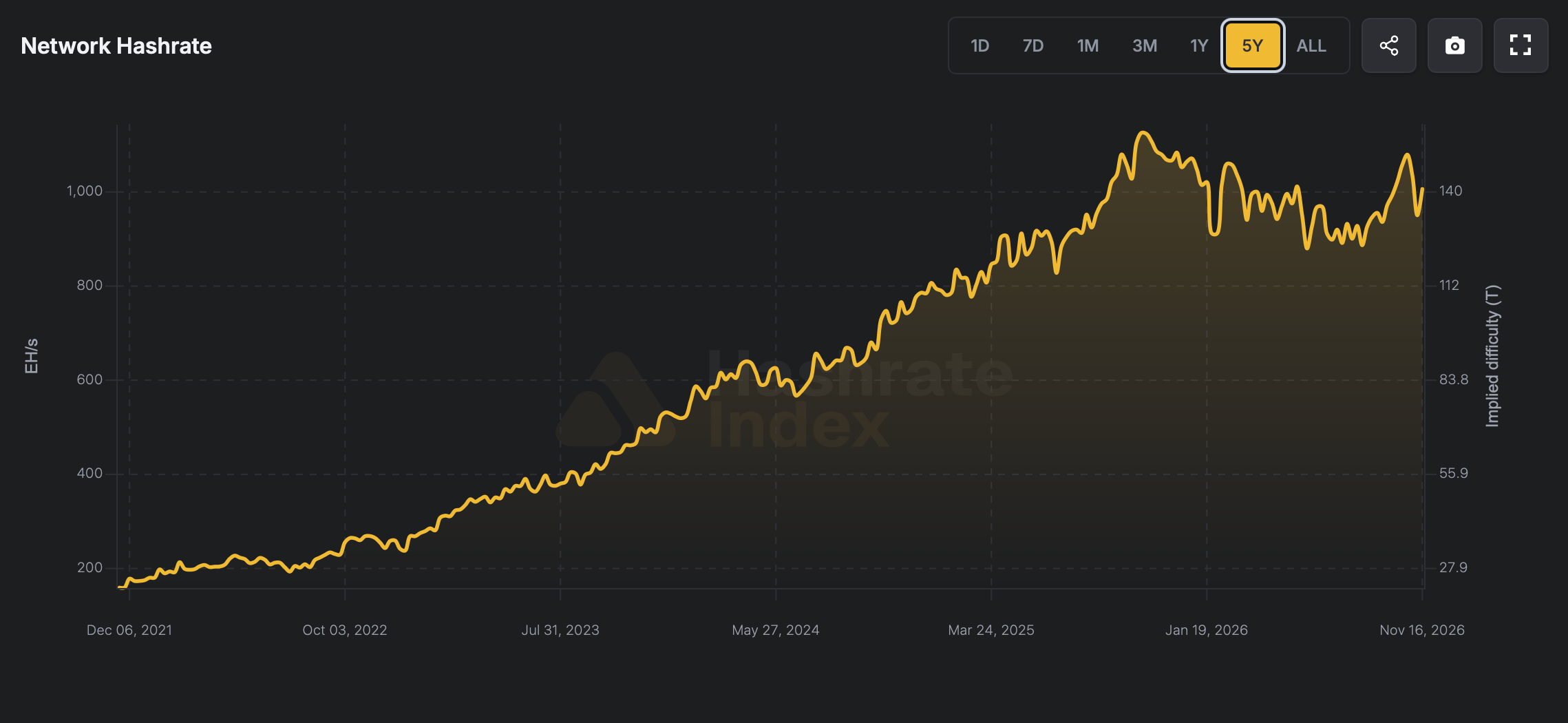
Bitcoin’s total hashrate (five-year timeframe) via hashrateindex.com on Nov. 21, 2026.
The move was preceded by a 9.13% difficulty reduction, which gave miners a good boost. However, with roughly a week remaining before the next difficulty adjustment, those recent gains could prove short-lived. The next adjustment is expected on or around Nov. 27, 2026, with current estimates pointing to an 8.99% increase in mining difficulty. The projected increase stems from Bitcoin’s block intervals running considerably faster than the network’s intended 10-minute average.
Although the estimate remains subject to change, blocks are currently being discovered every 9 minutes and 10 seconds on average. Bitcoin’s hashrate recovery offers little reassurance when viewed against the broader financial pressures confronting miners. A network reclaiming computational power while operators grapple with dwindling earnings hardly shows a mining industry with sound financial health.
At such depressed hashprices, miners are undoubtedly relying on sunk investments, existing capital reserves or sheer optimism to sustain operations. Even their bitcoin reserves are dwindling, leaving miners with fewer financial resources to withstand an increasingly unforgiving economic environment.