Bitcoin didn’t crash 70%, but Kraken’s order book did – Here’s what went wrong
英語の原文翻訳を見る
文字サイズ本文を読む ↓
画像を読み込み中
Kraken's BTC/CAD market's 70% price collapse has raised questions about market-maker liquidity and trading risks.
Crypto exchange Kraken recently faced a flash crash that was caused by a liquidity shortage in one of its Canadian-dollar trading markets, rather than an actual crash in Bitcoin [BTC]’s global market price.
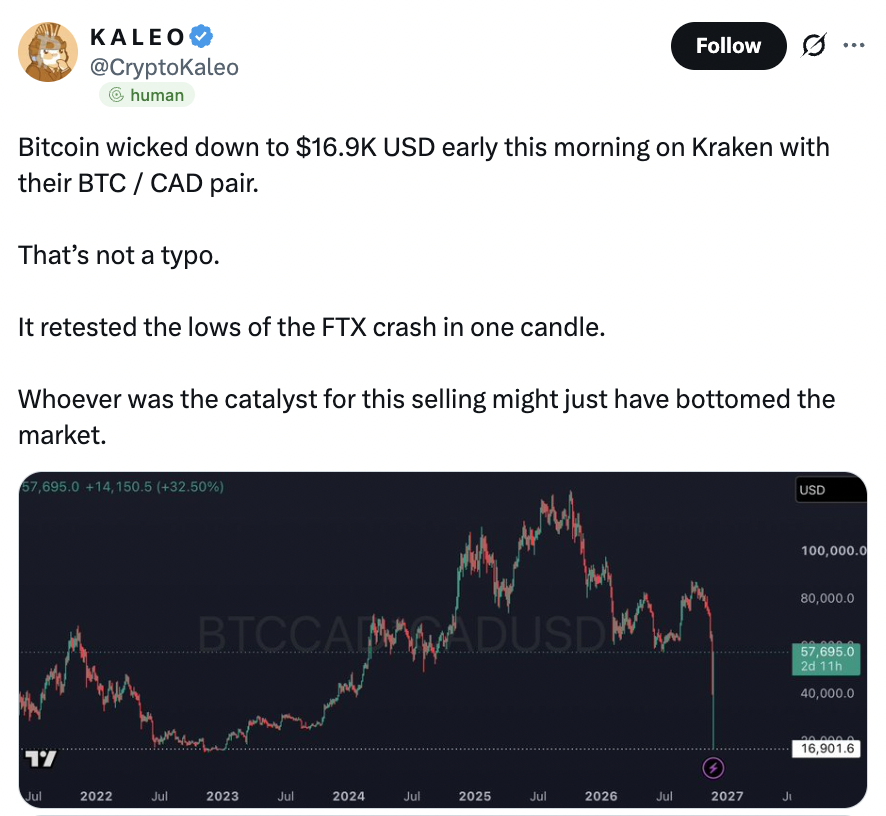
Over the weekend, Bitcoin’s price on Kraken’s BTC/CAD trading pair suddenly dropped to C$24,250. This was equivalent to approximately $16,900 at the prevailing USD/CAD exchange rate.
Source: X
This came as a shock because Bitcoin was trading around $57,650 on Kraken’s BTC/USD market during that period. In Bitcoin trading at nearly 70% below its price on other markets.
However, this was not a market-wide Bitcoin crash, as other major exchanges continued to show Bitcoin trading between $55,000 and $60,000.
What went wrong with Kraken?
The primary suspected reason was a sudden shortage of liquidity in Kraken’s BTC/CAD order book. This liquidity shortage, aka liquidity vacuum, is what caused a sudden price crash without Bitcoin’s actual market value declining.
Expressing their opinion on the matter, Blockstream CEO Adam Back suggested that the disruption may have originated from a market maker running out of funds in Kraken’s USD/CAD market.
As expected, this distortion may have spread to other CAD trading pairs through arbitrage, where traders buy assets at lower prices and sell them elsewhere at higher prices.
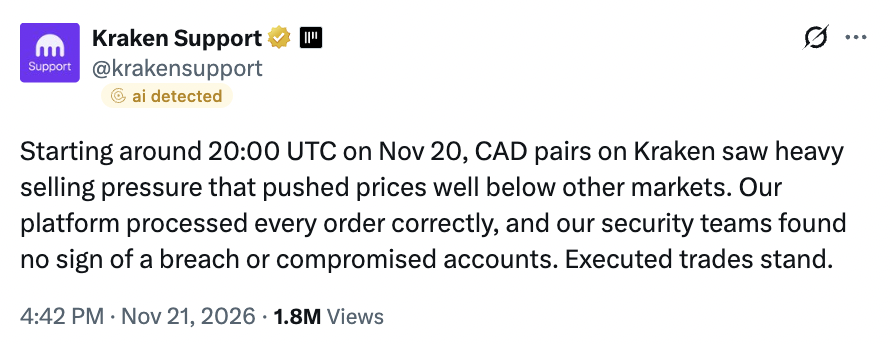
However, Kraken has not confirmed this explanation, yet. The exchange maintained that all orders were processed correctly and refused to reverse completed trades.
Source: Kraken support/X
What’s more?
This followed the exchange experiencing a one-hour technical outage on 30 October 2026, affecting its website, app, and trading APIs.
But at the same time, Kraken recently expanded its xStocks platform to over 1,000 tokenized stock listings, according to AMBCrypto’s previous report.
Final Summary
• Adam Back suggested that the disruption may have originated from a market maker running out of funds in Kraken’s USD/CAD market.
• The disruption reportedly stemmed from a shortage of market makers, also affecting ETH, XRP, and USDT trading pairs.