








Fusionist ACE Bridge Exploit: $5.7M Loss Estimate, Bithumb Freezes Trading
英語の原文翻訳を見る
文字サイズ本文を読む ↓
画像を読み込み中
Key takeaways The Fusionist ACE bridge exploit is estimated at $5.7 million across two stages, according to SlowMist, which is not an audited final total. About $1.87 million in proceeds was traced to the attacker, while 53.7 million genuine ACE tokens, valued near $3.7 million, were reportedly withdrawn through the bridge. Bithumb halted ACE trading on November 23 after finding signs that abnormally issued ACE had entered exchanges. In the material reviewed, Fusionist has not published a reconciled loss figure or a technical post-mortem. The Fusionist ACE bridge exploit has produced an estimated $5.7 million in losses across two stages, according to SlowMist’s incident tracker. After unbacked ACE tokens were minted on BNB Chain and sold, t…
Reason to trust

Strict editorial policy that focuses on accuracy, relevance, and impartiality
Morbi pretium leo et nisl aliquam mollis. Quisque arcu lorem, ultricies quis pellentesque nec, ullamcorper eu odio.
• The Fusionist ACE bridge exploit is estimated at $5.7 million across two stages, according to SlowMist, which is not an audited final total.
• About $1.87 million in proceeds was traced to the attacker, while 53.7 million genuine ACE tokens, valued near $3.7 million, were reportedly withdrawn through the bridge.
• Bithumb halted ACE trading on November 23 after finding signs that abnormally issued ACE had entered exchanges.
• In the material reviewed, Fusionist has not published a reconciled loss figure or a technical post-mortem.
The Fusionist ACE bridge exploit has produced an estimated $5.7 million in losses across two stages, according to SlowMist’s incident tracker. After unbacked ACE tokens were minted on BNB Chain and sold, traders reportedly used the resulting price collapse to withdraw real ACE from the project’s Endurance bridge reserves. The fallout reached centralized exchanges on Monday, November 23: Bithumb halted ACE trading after finding indications that abnormally issued tokens had entered crypto exchanges.
This was not one attacker walking away with $5.7 million in a single transaction. The distinction matters. Roughly $1.87 million was traced through the attacker’s proceeds, while another 53.7 million genuine ACE tokens, valued around $3.7 million at the incident’s reference prices, were reportedly withdrawn through the bridge. SlowMist lists a combined $5.7 million loss estimate, not an audited final total. The bridge’s most basic promise, that a token issued on one chain corresponds to something real on another, is precisely what now needs proving.
A Privileged Minter Printed Tokens That Had No Backing
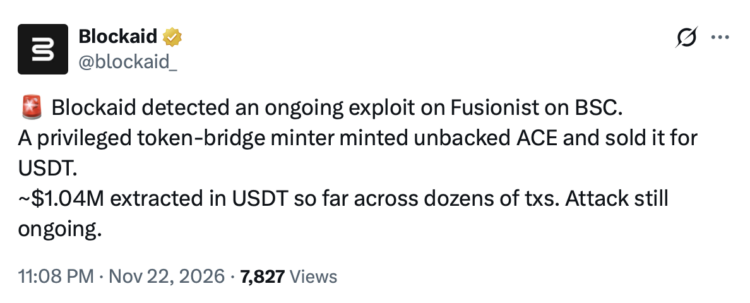
Security firm Blockaid flagged the Fusionist bridge-minter exploit on November 22. Its alert described the mechanism bluntly:
“ A privileged token-bridge minter minted unbacked ACE and sold it for USDT. Blockaid · November 22 alert
The firm initially estimated that about $1.04 million had been extracted while the attack was still ongoing. That was an interim snapshot, not a cap on the damage.
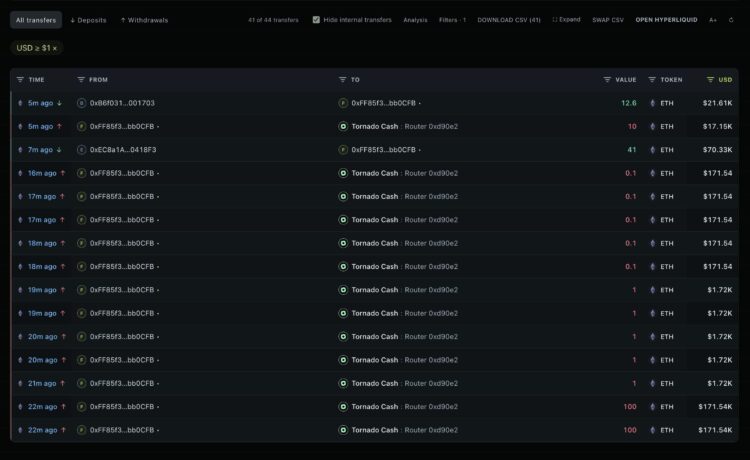
Blockchain-monitoring account Onchain Lens subsequently reported that an attacker had routed 1,091.5 ETH, valued at about $1.87 million at the time, through Tornado Cash. That observation traces a movement of proceeds, not an extra $1.87 million to add on top of the initial extraction estimate. The values describe different points in the same suspected attacker’s fund flow.
Fusionist acknowledged an apparent ongoing ACE exploit on BNB Smart Chain on Sunday and asked users to suspend transfers, trading and bridging on that network. It has not, in the material reviewed, provided a reconciled loss figure or a technical post-mortem identifying how the privileged minting authority was abused.
A bridge minter is supposed to create a token representation only when the corresponding value is properly accounted for. Once the right to mint is misused, a chain can show perfectly ordinary-looking balances that have no matching backing.
It is a familiar failure mode: NewsBTC previously covered a bridge-role exploit that minted unbacked tokens at CrediX. That earlier case does not establish Fusionist’s root cause, but it illustrates why elevated bridge permissions are such a consequential security boundary.
Traders Found a Second Exit Through Real ACE Reserves
The subsequent drain may prove more important than the initial minting spree.
According to SlowMist’s November 22 incident entry, traders bought the sharply discounted ACE created by the market disruption and used the cross-chain bridge to withdraw about 53.7 million genuine ACE from the Endurance-side reserves. SlowMist valued that withdrawal at approximately $3.7 million.
Here is the mechanism without the jargon. A representation of ACE on BNB Chain suddenly became cheap because unauthorized supply had flooded the market. A bridge that would still accept those tokens in exchange for ACE on Endurance offered an obvious difference in value.
Anyone able to complete that conversion could receive real tokens in return for deeply discounted ones. The trading opportunity existed because the backing and the circulating representation were no longer in a trustworthy relationship.
The $3.7 million figure is a valuation of the ACE reserve outflow, not proof that every recipient sold those tokens for $3.7 million in cash. Nor does it mean every trader involved helped compromise the minter.
There is a meaningful difference between initiating the security breach and trading through a system whose defenses have already failed.
Those distinctions should not obscure the core problem. A bridge can have technically valid transactions and still produce an economically disastrous result. If unbacked supply can be redeemed for genuine reserves, the checks have failed where they matter most.
Bithumb’s Monday Halt Shows How Far the Problem Travelled
Bithumb suspended ACE deposits and withdrawals early on November 23. It then halted trading effective 7:30 a.m. Korea time, according to its follow-up ACE security notice.
The exchange said, in a translation from its Korean announcement, that it had:
“ confirmed indications that abnormally issued ACE had entered cryptocurrency exchanges. Bithumb · ACE security notice
It identified two related BNB Chain transactions and a second transaction.
Those records are important evidence leads, but a full independent decoding of the transaction trail remains outstanding.
Bithumb’s wording is careful: it reported signs of abnormal supply entering exchanges, not a finding that every ACE token in customer accounts is invalid. The trading suspension is a protective response, not a finalized determination of customer losses.
Still, it creates a practical problem for holders who never used the bridge. If tokens are fungible within a market, exchanges and the issuer need a credible method for identifying affected supply and deciding how deposits, balances and trades will be treated.
The Real Security Question Is Why the Bridge Could Honor the Claims
There is an understandable temptation to focus on the enormous minting figures. The more consequential question is what happened when those tokens met the bridge’s reserves.
A system does not need to lose control of its entire blockchain to suffer a serious failure in one privileged contract role. Nor should a successful-looking bridge transaction count as evidence that the asset being transferred was fully backed.
The response cannot end with a pause notice and a promise to investigate.
Fusionist needs to show which minting permissions were affected, whether they have been revoked, how much ACE was created without backing, how the Endurance-side reserve changed and what claims remain outstanding.
Exchanges need a defensible token-treatment plan, and holders need to know whether there is a shortfall and who is responsible for covering it.
There is a fair counterargument: the $5.7 million figure is an external estimate, market prices moved during the incident, and the precise compromise method is not established.
SlowMist categorizes the incident as private-key leakage, but that classification is not a substitute for an official technical finding. It would also be premature to treat a cautious exchange halt as proof that every affected customer suffered a loss.
Those qualifications change how the numbers should be reported. They do not make the underlying bridge-accounting failure less serious.
The next credible milestone is not a restored interface or a reassuring social post. It is a transparent reconciliation of the tokens minted, the reserves withdrawn and the assets still available to back legitimate ACE claims.
Until that exists, the estimated $5.7 million fallout remains a warning about both token security and the risks of trusting a bridge’s accounting.
Disclaimer: this article is for informational purposes only and is not financial advice.